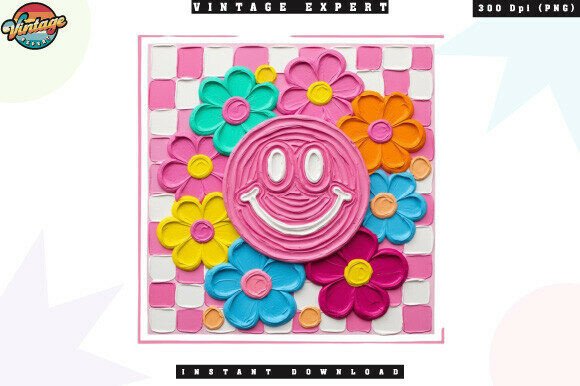
The Happy Face Flower Patch Aesthetic: Where Color, Joy, and Digital Design Bloom
In the ever-evolving world of digital design, certain styles emerge that capture a universal feeling. The combination of a "Happy Face Flower Patch Aesthetic" – a cute and colorful smiley face intertwined with vibrant flowers rendered in a soft 3D clay style – is one such phenomenon. It represents more than just a graphic; it embodies a movement towards positivity, playful creativity, and the seamless integration of art into our daily lives through apparel, decor, and digital media. This article explores this delightful aesthetic from the ground up, examining its purpose, its significance in modern creative culture, and its vast practical applications.
A Blossoming Design: Deconstructing the Aesthetic Elements
To understand its appeal, let's break down the core components of this popular design style. It is a harmonious fusion of three key visual concepts.
The Universal Symbol: The Smiley Face
The smiley face is arguably one of the most recognizable symbols in the world. Its simple, circular form and curved line smile convey immediate, unambiguous happiness. In design psychology, it triggers positive emotional responses and a sense of friendliness. When integrated into more complex artwork, it acts as an anchor of joy, ensuring the overall message is uplifting and approachable.
Nature’s Palette: Vibrant Flowers
Flowers are nature’s own celebration of color and life. Incorporating vibrant blooms—like daisies, sunflowers, or whimsical fantasy blossoms—adds a layer of organic beauty and complexity. The flowers aren't just background; they often interact with the smiley, perhaps framing it, growing from it, or sharing its space. This merges human emotion (the smile) with natural beauty, suggesting a world where joy and growth are intertwined.
The Tactile Touch: Soft 3D Clay Style
The "soft 3D clay style" is a critical rendering technique that gives the design its contemporary charm. Unlike flat vector graphics or hyper-realistic 3D, this style mimics the look of hand-molded clay or putty. It has gentle shadows, rounded edges, and a slightly textured appearance that feels tactile and warm. This approach makes the design feel handmade, friendly, and accessible, evoking childhood crafts and a sense of playful innocence. It bridges the digital and the physical, making viewers imagine they could almost touch the cheerful scene.
Significance and Purpose: More Than Just a Pretty Picture
This aesthetic serves a deeper purpose in today's visual culture. In a digital age often marked by complexity and noise, it offers a clear, unadulterated dose of positivity. Its significance lies in its versatility as a tool for communication and branding.
Emotional Resonance: Primarily, it is designed to evoke happiness. It taps into a nostalgic, carefree feeling that appeals across generations—from children who adore its bright colors to adults who appreciate its whimsical escape. It’s a visual form of optimism.
Creative Flexibility: As a PNG file with a transparent background, it is a designer’s versatile asset. It can be placed on any colored fabric, digital background, or product template without the need for complex editing, making it a practical tool for rapid creativity.
Commercial Appeal: Its purpose extends strongly into the realm of commerce, particularly in the booming Print-on-Demand (POD) market. Designs that are universally likable, non-controversial, and emotionally engaging are key drivers for products like t-shirts, mugs, and stickers.
Fitting into Modern Life: Practical Relevance and Applications
The Happy Face Flower Patch design is not confined to a digital file; it flourishes across multiple facets of modern life, work, and creativity.
Kid-Centric Worlds and Education
In environments for children, this aesthetic is perfect. Its friendly, non-threatening appearance makes it ideal for educational materials, room decor, children’s book illustrations, and playful websites. It can help create a welcoming and stimulating atmosphere that encourages learning and joy.
The Boom of Fun Apparel and Merchandise
The directive "perfect for kids, fun apparel, and cheerful aesthetic t-shirt designs" highlights its primary commercial application. The POD model allows entrepreneurs and creatives to license such designs and apply them to a vast array of products without inventory risk. A single high-quality PNG file becomes the heart of a t-shirt, a tote bag, a laptop sleeve, or a sticker. This democratizes fashion and merchandising, enabling anyone to sell products infused with this specific joyful aesthetic.
Digital Projects and Social Media
Beyond physical products, the 300 DPI, high-resolution file is excellent for digital projects. Bloggers, social media content creators, and website designers can use it as a vibrant header graphic, a cheerful icon, or an engaging visual in online content to boost positivity and engagement.
Crafting and Personal Creativity
The DIY community embraces such files for personal crafts. With a transparent background, crafters can use it for creating custom greeting cards, scrapbook pages, vinyl decals for personal items, or framed artwork. It empowers personal expression through a professional-quality graphic.
Understanding the Technical Details: A Foundation for Success
To leverage this design fully, understanding its product specifications is crucial. These are not arbitrary; they are engineered for maximum utility.
- File Type & Quality: The single "high-quality PNG file" ensures a lossless format perfect for digital use. PNG supports transparency, which is its standout feature.
- Dimensions (4500px x 5400px): This large canvas size provides immense flexibility. It can be scaled down for small items like stickers without loss of detail or used at full size for large format prints like pillows or posters.
- Transparent Background: This is the key to versatility. It allows the design to sit naturally on any colored or patterned background of a product or project without a harsh white border, creating a seamless, professional integration.
- Resolution (300 DPI): DPI (Dots Per Inch) is the standard for high-quality printing. 300 DPI ensures that when printed, the image is sharp, crisp, and without pixelation, whether on fabric or paper.
- Commercial Use License: This permission is vital for business applications. It explicitly allows the file to be used on POD products for sale, turning a graphic into a revenue-generating asset.
- Instant Digital Download: This aligns with the speed of modern e-commerce and creativity, providing immediate access to start projects.
Clarifying Common Misunderstandings
When working with such digital design assets, certain assumptions can lead to confusion. Clarifying these helps users have a smooth experience.
"It's an editable source file." A common assumption is that a PNG file is fully editable like a layered Photoshop file. It is not. The PNG is a final, flattened image. You can resize it and place it on backgrounds, but you cannot easily edit the individual clay-style flowers or smiley face elements separately. This is why the design is provided as a ready-to-use asset.
"Colors will match exactly on all outputs." The note about colors appearing different due to monitor settings and print materials is critical. Digital screens (RGB color space) and printers (often CMYK) render colors differently. The vibrant flowers might look slightly brighter on screen and a tad softer on a cotton t-shirt. This is a normal part of the physical printing process, not a flaw in the file.
"Commercial Use means I can resell the digital file." This is a crucial distinction. The license typically allows you to sell physical products that feature the design. It explicitly prohibits the resale or redistribution of the digital file itself. You cannot sell the PNG file to another person. This protects the designer's intellectual property while allowing you to use it as a tool for your own product-based business.
Building a Broader Understanding: The Design in Context
The Happy Face Flower Patch aesthetic sits within larger trends in design and society. It reflects a growing appetite for positive visual communication in response to stressful times. It aligns with the maker movement and the democratization of design through POD platforms, where individual artists can share their work globally. Technologically, it leverages the power of simple, scalable, and portable digital file formats (like PNG) that have become the backbone of online creative commerce.
Ultimately, this cheerful design is more than a product detail list. It is a gateway. For the entrepreneur, it’s a scalable asset for a business. For the crafter, it’s a spark of inspiration. For the consumer, it’s a wearable or usable piece of joy. And for the designer, it represents a successful synthesis of emotion, nature, and technique into a single, powerful, and versatile digital artwork. By understanding its elements, purpose, and proper use, anyone can harness this blooming patch of happiness to color their world, their projects, and even their wardrobes with a smile.